Gen Z Banking Statistics: 2026 Report

Our analysts reviewed the Federal Reserve's Report on the Economic Well-Being of U.S. Households in 2025, published in May 2026, and the FDIC's 2023 National Survey of Unbanked and Underbanked Households, the latest edition, as of Q4 2026. We charted how the youngest age groups in each survey access their bank accounts, how many have no bank account, and how they use credit cards, Buy Now, Pay Later, and student loans.
Both surveys report by age rather than generation. Gen Z was born from 1997 to 2012, so adults aged 18 to 29 in 2025 and households aged 15 to 24 in 2023 are mostly or entirely Gen Z.
Key Findings
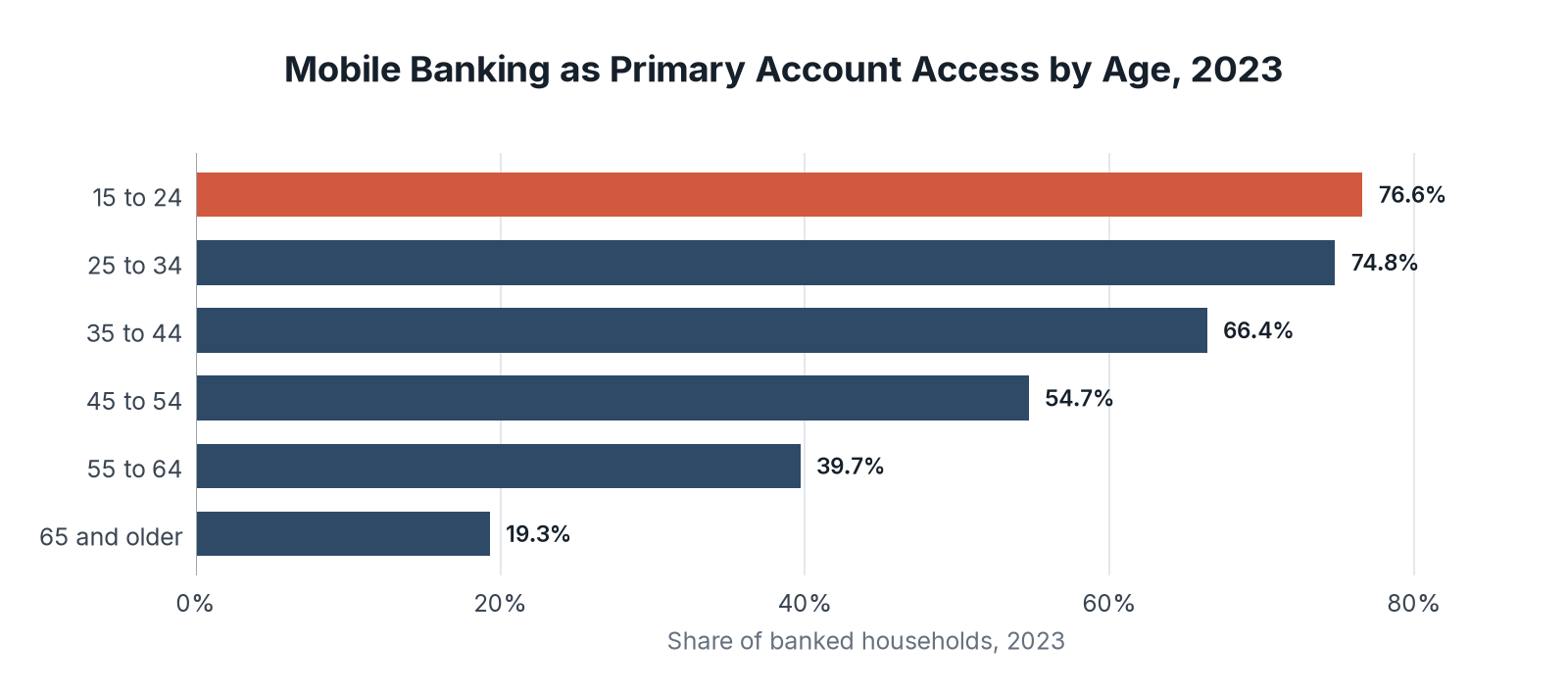
- 76.6% of banked households aged 15 to 24 used mobile banking as their main way to reach their account in 2023, the highest share of any age group.
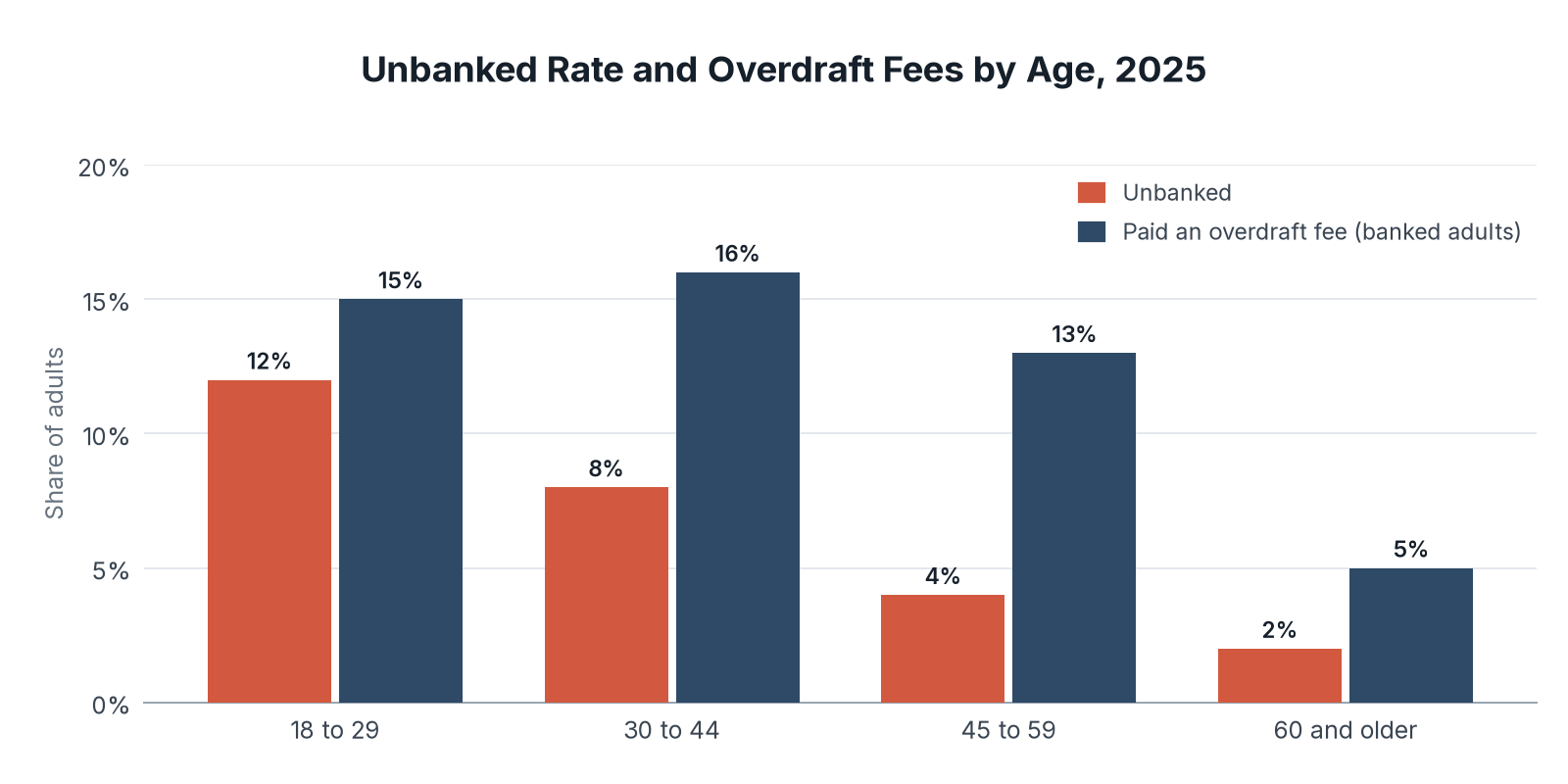
- 12% of adults aged 18 to 29 had no bank account in 2025, twice the 6% rate for all adults.
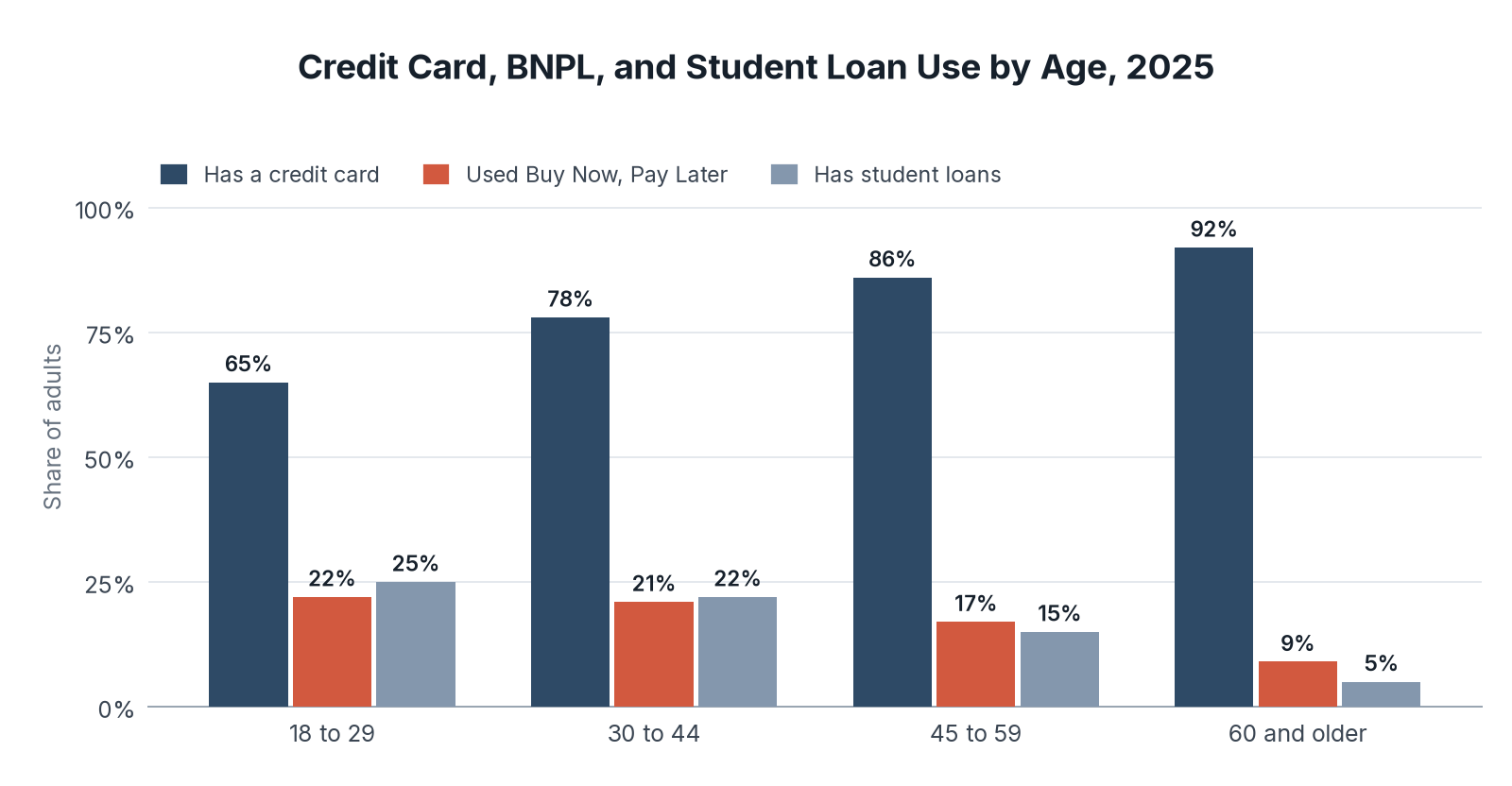
- 22% of adults aged 18 to 29 used Buy Now, Pay Later in 2025, and 32% of those users paid late.
- 65% of adults aged 18 to 29 had a credit card in 2025, compared with 82% of all adults.
Three in Four Young Households Bank Mainly on a Phone
The FDIC asks banked households which method they use most to reach their account. Mobile banking leads in every age group under 55, and its share falls with each older group.
| Age of householder | 2019 | 2021 | 2023 |
|---|---|---|---|
| 15 to 24 | 62.9% | 74.1% | 76.6% |
| 25 to 34 | 61.7% | 69.4% | 74.8% |
| 35 to 44 | 49.8% | 60.5% | 66.4% |
| 45 to 54 | 36.3% | 49.1% | 54.7% |
| 55 to 64 | 21.3% | 33.2% | 39.7% |
| 65 and older | 8.3% | 15.3% | 19.3% |
Key Findings
- Mobile banking as the main access method rose from 62.9% to 76.6% of banked households aged 15 to 24 between 2019 and 2023.
- 5.5% of banked households aged 15 to 24 relied mainly on a bank teller in 2023, compared with 30.4% of households aged 65 and older.
- Across all banked households, 48.3% used mobile banking as their main method in 2023, and 91.2% used two or more methods.
Adults Under 30 Are the Most Likely to Be Unbanked
Younger adults have the highest unbanked rate of any age group in the Federal Reserve survey. Among those with an account, adults under 45 paid overdraft fees at about three times the rate of adults aged 60 and older.
| Age | Unbanked | Paid an overdraft fee (banked adults) |
|---|---|---|
| 18 to 29 | 12% | 15% |
| 30 to 44 | 8% | 16% |
| 45 to 59 | 4% | 13% |
| 60 and older | 2% | 5% |
Key Findings
- Adults aged 18 to 29 were six times as likely as adults aged 60 and older to have no bank account in 2025.
- 17% of adults aged 18 to 29 used nonbank check cashing or money orders in 2025, compared with 12% of all adults.
- The FDIC put the unbanked rate for households aged 15 to 24 at 5.9% in 2023, compared with 4.2% for all households.
Young Adults Use Buy Now, Pay Later More and Credit Cards Less
Credit card ownership rises with age, while Buy Now, Pay Later and student loans are most common among adults under 30. Among adults under 45, student loans were slightly more common than Buy Now, Pay Later use.
| Age | Has a credit card | Used Buy Now, Pay Later | Has student loans |
|---|---|---|---|
| 18 to 29 | 65% | 22% | 25% |
| 30 to 44 | 78% | 21% | 22% |
| 45 to 59 | 86% | 17% | 15% |
| 60 and older | 92% | 9% | 5% |
Key Findings
- 46% of credit card holders aged 18 to 29 carried a balance at least once in the prior year, close to the 45% rate for all cardholders.
- 32% of Buy Now, Pay Later users aged 18 to 29 paid late, compared with 12% of users aged 60 and older.
- 9% of adults aged 18 to 29 used a payday, pawn, auto title, or refund anticipation loan in 2025, compared with 7% of all adults.
How Adults Under 30 Compare With All Adults
The Federal Reserve survey shows the youngest adults less connected to mainstream banking and credit, and more reliant on newer and alternative products. They also reported financial fraud less often than older adults.
| Measure, 2025 | Adults 18 to 29 | All adults |
| --- | --- | --- |
| Unbanked | 12% | 6% |
| Paid an overdraft fee (banked adults) | 15% | 12% |
| Used nonbank check cashing or money orders | 17% | 12% |
| Has a credit card | 65% | 82% |
| Used Buy Now, Pay Later | 22% | 16% |
| Paid a Buy Now, Pay Later loan late (users) | 32% | 26% |
| Has student loans | 25% | 16% |
| Experienced any financial fraud | 13% | 20% |
Key Findings
- Adults aged 18 to 29 used Buy Now, Pay Later at a rate 6 percentage points higher than all adults.
- 25% of adults aged 18 to 29 had student loans, the highest share of any age group.
- 13% of adults aged 18 to 29 experienced financial fraud in 2025, compared with 26% of adults aged 60 and older.
What the Numbers Mean for Gen Z Banking
Gen Z banks on a phone first and leans on newer credit products such as Buy Now, Pay Later more than any older group. At the same time, more young adults have no bank account at all, and fewer hold a credit card, one of the most common ways to build a credit history.
Credit card ownership rises steadily with age in the Federal Reserve data, so many of today's young adults will add cards as their incomes grow. The next Federal Reserve survey, covering 2026, will show whether the 12% unbanked rate for adults under 30 falls as more of Gen Z enters the workforce.
So if you are in your teens or twenties, open a checking account with no overdraft fees and pay any Buy Now, Pay Later plan on time, because 32% of young users fall behind.
Data Collection and Methodology
We reviewed sources available in Q4 2026. Federal Reserve figures come from its Survey of Household Economics and Decisionmaking, published in May 2026 as the Report on the Economic Well-Being of U.S. Households in 2025, and cover adults aged 18 and older. FDIC figures come from its 2023 National Survey of Unbanked and Underbanked Households, conducted with the June 2023 Current Population Survey, and cover households grouped by the age of the householder. Mobile banking figures are among banked households that accessed their account in the prior 12 months. The two surveys use different age bands and units, so their figures are best read within each source.
Sources
- Fintech Index, Gen Z Banking Study: analysis of Federal Reserve and FDIC survey data on banking, account access, and credit use by age, conducted November 2026.
- Board of Governors of the Federal Reserve System, Economic Well-Being of U.S. Households in 2025: Banking
- Board of Governors of the Federal Reserve System, Economic Well-Being of U.S. Households in 2025: Credit
- FDIC, 2023 National Survey of Unbanked and Underbanked Households
- Table 1: Source: FDIC, 2023 National Survey of Unbanked and Underbanked Households. Data: fdic_mobile_banking_primary_access_by_age_2023.csv
- Chart 1: Source: FDIC, 2023 National Survey of Unbanked and Underbanked Households.
- Table 2: Source: Federal Reserve, Report on the Economic Well-Being of U.S. Households in 2025. Data: fed_unbanked_and_overdraft_by_age_2025.csv
- Chart 2: Source: Federal Reserve, Report on the Economic Well-Being of U.S. Households in 2025.
- Table 3: Source: Federal Reserve, Report on the Economic Well-Being of U.S. Households in 2025. Data: fed_credit_card_bnpl_student_loan_use_by_age_2025.csv
- Chart 3: Source: Federal Reserve, Report on the Economic Well-Being of U.S. Households in 2025.
- Table 3: Source: Federal Reserve, Report on the Economic Well-Being of U.S. Households in 2025. Data: fed_credit_card_bnpl_student_loan_use_by_age_2025.csv